Ptah, Alchemy, and the Inner Flame
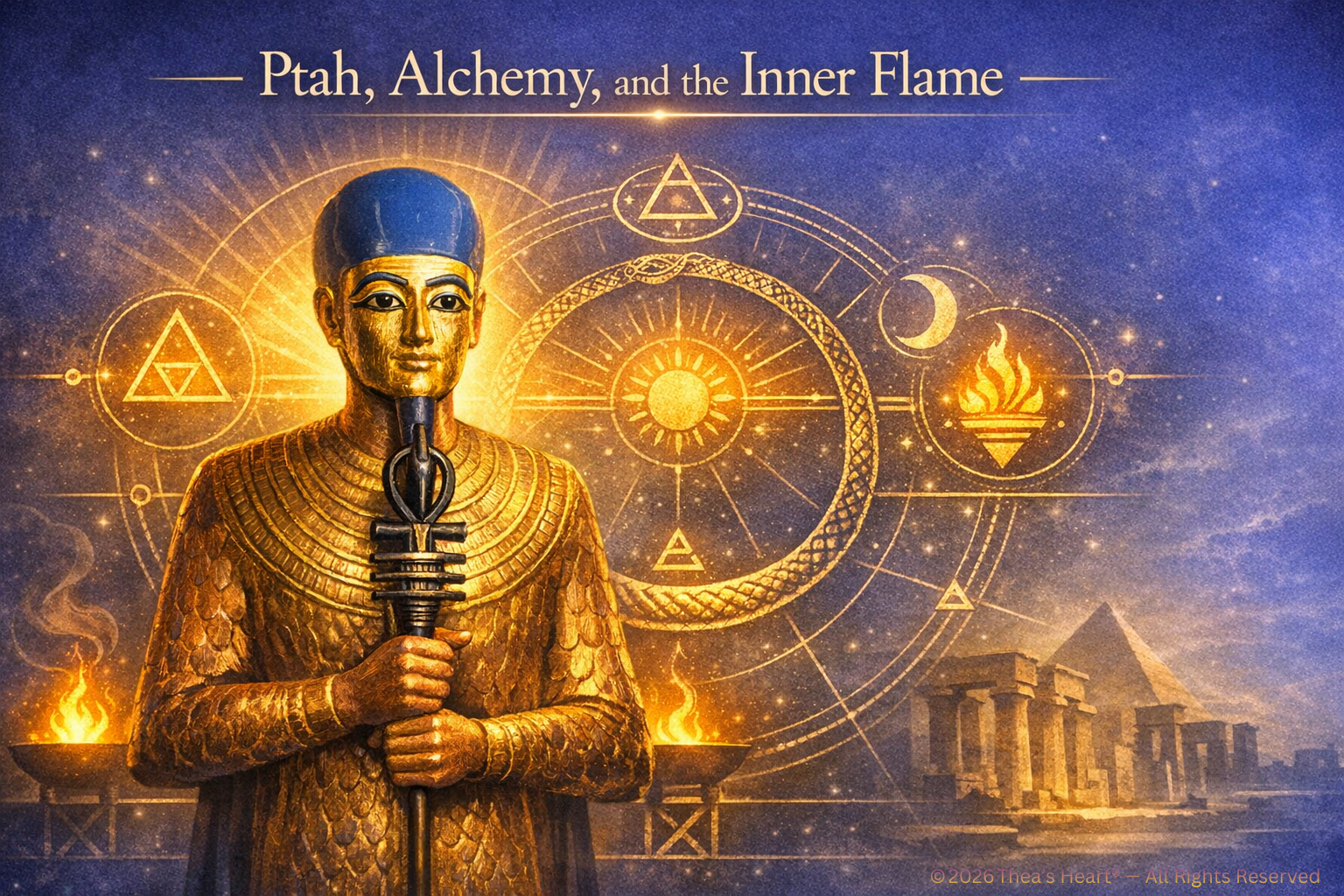
Ptah, Alchemy, and the Inner Flame invites you into a conversation the ancients began long before we arrived, a conversation about fire, creation, and the intelligence that shapes worlds. What started as a simple image of Ptah unfolded into a deeper remembering: of triads, cosmic hearths, and the blue fire that births stars. This piece is an offering for anyone who feels the fiery spark rising within them.
When I first sat with an image of Ptah, something subtle but insistent stirred. A simple depiction of an Egyptian creator god became a doorway — not into history, but into memory. The blue cap, the straight beard, the staff woven from Ankh, Djed, and Was… each symbol opened like a seed pod, revealing layers of meaning I hadn’t expected. What began as a quick social post became a thread, then artwork, and finally an exploration that asked for more space, more breath, and more depth.
Ptah is said to create through the fire of his heart — thought ignited into form through speech. And the more I looked, the more that fire revealed itself.
Ptah, Alchemy, and the Inner Flame: The Symbolism That Speaks
Egyptian symbolism is never singular. Meaning is layered, intentional, and alive.
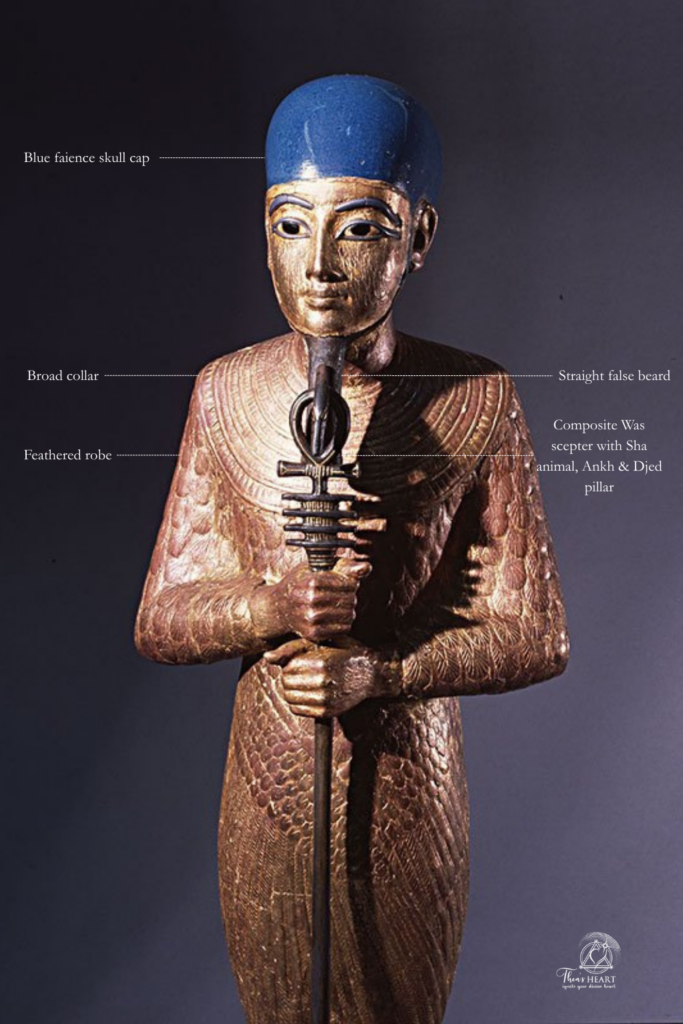
- The straight false beard signals divinity and continuity.
- The broad collar reflects cosmic order and protection.
- The staff combining Ankh, Djed, and Was unites life, stability, and power.
- The feathered robe hints at Ma’at — balance, truth, and the harmony of creation.
- The blue skullcap, often rendered in lapis, appears here in ceramic — yet its color still whispers of heat, intensity, and the hottest flame.
Image of Ptah from the Tutankhamun Collection, carved in gilded wood and wrapped in a feather‑patterned shroud, wearing a blue faience skullcap with faience‑and‑stone inlaid eyes. Diagrammed by Althea Provost to highlight key Memphite iconography.
GEM, Giza. JE 60739 / GEM 01/01/14820. Provenance: Valley of the Kings, Thebes, Upper Egypt. 18th Dynasty, reign of Tutankhamun (Nebkheperure).
Blue is not cold in the language of fire. Blue is the point of highest combustion, the place where matter transforms most completely.
NASA notes that newborn stars emit most of their energy in the blue and ultraviolet spectrum — creation at its most potent. The ancients knew this in their own way. They carved it into stone.
Ptah, Alchemy, and the Inner Flame: A Triad of Creation
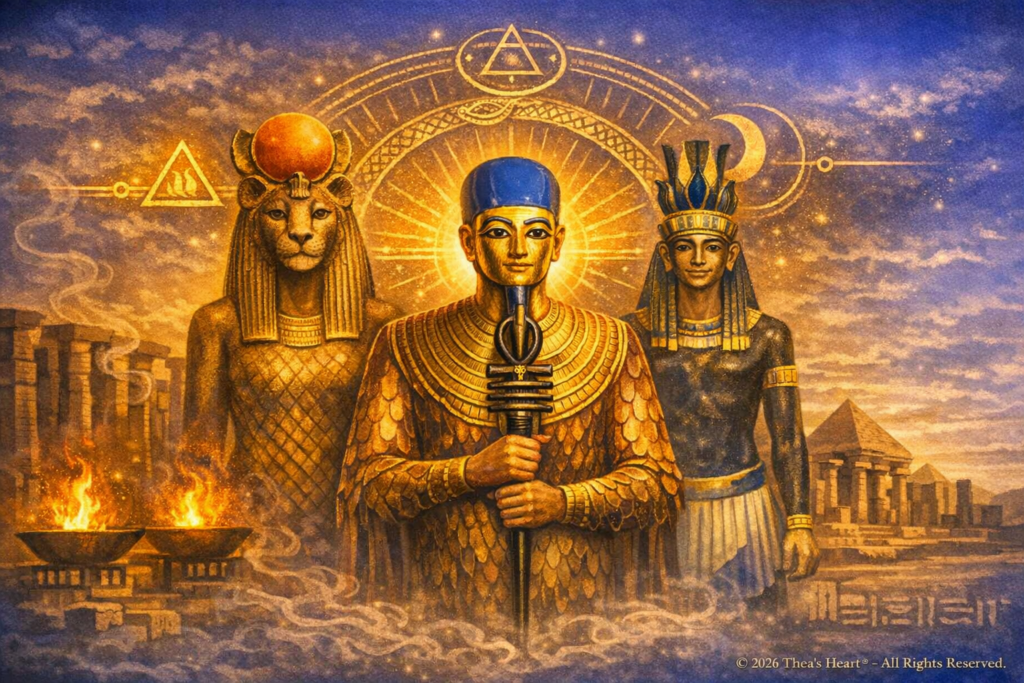
In the Memphite tradition, Ptah does not stand alone. He forms a triad with Sekhmet and Nefertem — a cycle of creation, purification, and renewal.
Ptah — the creator, the architect of form, the one who brings thought into being through the fire of the heart.
Sekhmet — Lady of the Flame, she embodies the destructive, scorching heat of the sun. Her fire is not chaos; it is precision. She burns away what is out of balance, purifies what is stagnant, and restores cosmic order through heat intense enough to transform.
Nefertem — the new bloom, the lotus rising from the fire‑cleansed ground, the renewal that follows purification.
Creation → purification → renewal.
A cycle, not a hierarchy.
Yet when ancient balance meets modern code, the harmony shifts — AI systems built through a Western lens aren’t equipped to see the relational symmetry the Egyptians intended.
Ptah, Alchemy, and the Inner Flame: When the Modern AI Interprets Ancient Design
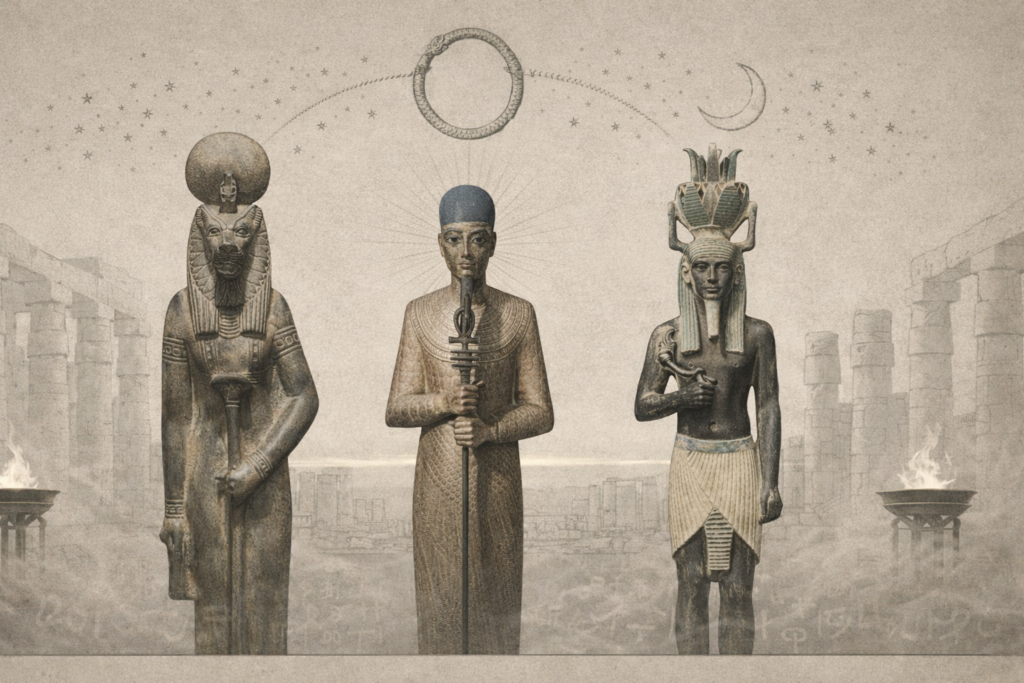
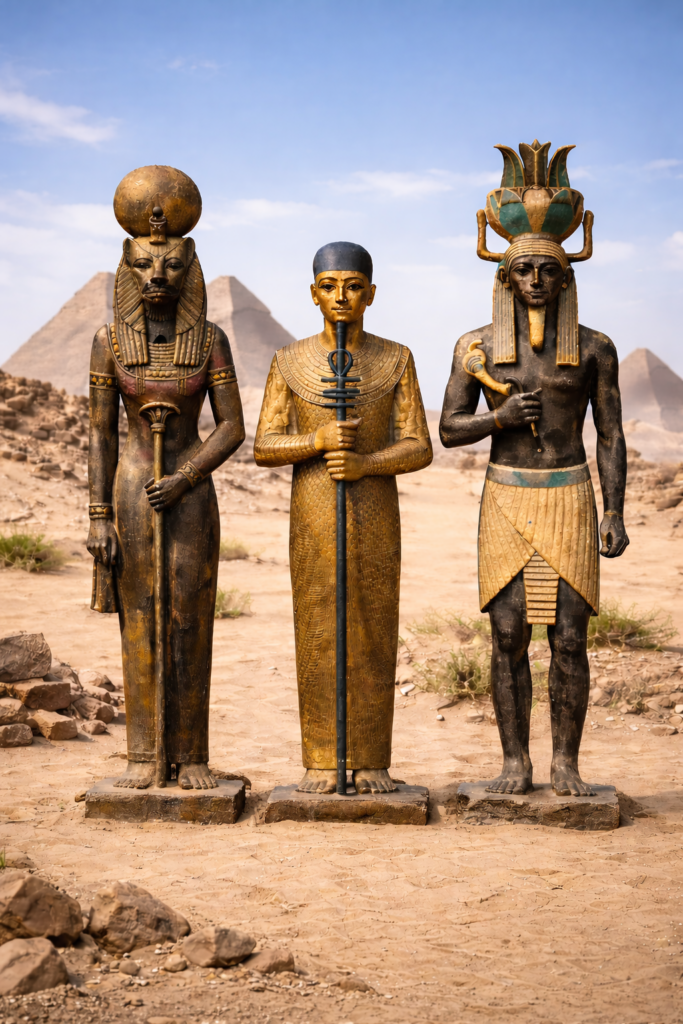
As I began creating artwork to support this article, my intention was to depict the Memphite triad — Ptah, Sekhmet, and Nefertem — standing as equals. Shoulder to shoulder. Balanced.
Soon, I found myself unable to create that image using a basic AI platform. The software insisted on arranging the triad into a pyramid shape, with one figure centered and elevated while the others were pushed into the foreground and diminished.
Every variation I tried only revealed the same pattern repeating itself. The hierarchy was baked into the architecture. The system defaulted to a top‑down structure, a worldview the ancient Egyptians never intended for this triad of Sekhmet, Ptah, and Nefertem. They were distinct in personality, yet equal in footing and expression.
And suddenly, the problem became the insight. The ancients encoded their cosmology openly, in crowns, in robes, in staffs, in stone. Their triads were not hierarchies. They were relationships. Cosmic forces in balance.
To restore that balance in the artwork, I had to override the algorithm.
Study its patterns.
Find its seams.
Push back until the triad stood as it was meant to stand.
This meant reaching out to people who use AI platforms I do not. I provided the exact words and commands so they could run those prompts through ChatGPT and Gemini on my behalf. Each system interpreted the instructions differently, and the generous people who offered their paid subscriptions for my trial and error had to make adjustments of their own.
To override the AI’s pyramid effect, one person ended up giving Nefertem’s youthful shape a more muscular frame so he appeared visually equal to his father. But in doing so, they introduced a distortion. To the ancient Egyptians, Nefertem’s force of renewal stood equal to the forces of creation and destruction — without needing the body of a warrior to validate it.
The Algorithm Reveals the Blind Spot
Have we forgotten how to see the symbiotic yet distinct roles of Sekhmet, Ptah, and Nefertem, in the way ancient Egyptians may have understood them? The AI’s distortions are not errors, the code simply reflects the worldview it was trained on.
Fun fact: to maintain a pyramid‑shaped composition, the AI system could not keep Sekhmet’s was-scepter in her hand as it appeared in the original prompt. Because Ptah stands in the foreground, the system compensated by giving him two was-scepters instead. AI also removed the khepresh flail from Nefertem’s hand, shifting the visual emphasis toward a single dominant figure — Ptah — rather than the relational balance of the triad.
Hierarchy imposed where none existed.
Other AI systems were able to preserve these elements after several coding requests, keeping the statues I supplied without heavy editing once the linearity was established.
Echoes Across Cultures
What Ptah revealed wasn’t separate from my own path. These symbols — fire, origin, creation — have been companions in my work for years. They surfaced again and again in my writing, my research, and my lived experiences, eventually leading me to define the term Starseed and explore its deeper roots.
This understanding didn’t come to me through study alone. Through personal encounters, inherent memory, and years of researching and exploring ancient cultures, I redefined the term Starseed in Four Aliens and a Funeral: A Memoir of Perception, expanding it beyond modern interpretations to include the ancient traditions that point to our cosmic roots in the stars. In the book, I write about the Maya and their understanding of humanity’s origin in the heavens.
What follows is a distilled version of the Starseed cosmology I developed in the opening of my book, offered here so the reader can more clearly understand how these ancient patterns inform my work. To see this clearly, it helps to recognize that creation stories across cultures often echo one another, pointing to shared origins and a common cosmic memory.
Among these ancient traditions, the Maya held a strikingly similar understanding of cosmic fire. Their Popol Vuh speaks of humanity emerging from the Orion Nebula — the Hearth of Creation. Their triadic pyramids mirror the three bright stars of Orion that frame M42, the birthplace of stars.
Science, too, affirms this concept. In 1957, Burbidge, Burbidge, Fowler, and Hoyle described how stars forge the elements that make us. As Neil deGrasse Tyson famously said: “We are not figuratively, but literally stardust.”
I’ve introduced the nature of fire through our ancient ancestors’ use of architecture, landscape, and ritual in my courses The White Road and Fire Ceremonies | Sacred Sites | Transmutation. These teachings explore how civilizations encoded their understanding of creation into stone, alignment, and ceremony. Within these courses, I also introduced the Maya cosmology and origin stories, the same stories I later expanded upon in my definition of Starseed.
I’ve also shared my direct experience with fire — including the kundalini rising I described in my article Outer Sight | Inner Sight, which recounts my awakening at the pyramidal site of Uxmal, Mexico.
My understanding of fire, memory, and origin comes from a blend of research, personal awakening, and over a decade of witnessing these same themes emerge during Starseed adventures.
Different cultures.
Different languages.
The same truth:
We are born of fire.
©2026 Thea’s Heart, LLC® – All Rights Reserved.