The Oracles of Antiquity | Althea Provost on Ancient Sight
The Oracles of Antiquity explores the intuitive traditions of ancient priestesses, the psychic vision associated with sacred sites, and the enduring mystery of the Delphic oracle. Through personal experiences at megalithic temples and historical reflections, Althea Provost examines how ancient oracles accessed insight and how these intuitive technologies continue to resonate today.
The Oracles of Antiquity: When Sacred Sites Became Teachers
My interest in clairvoyants from antiquity developed from psychic experiences at sacred sites. Each unique experience opened a new door to the mystery. Each unique encounter opened a new door to the mystery. Along the way, unplanned visits to bookstores became my attempt to understand the Neolithic landscape. My suitcase often filled with expensive, old dusty books, and my wallet grew lighter from airline baggage overages.
From temple development and construction to archeoastronomy and archaeoacoustics, from lay lines and earth magnetics, to antiquarian books, each site visit stirred a deeper desire to learn. I began to wonder who these ancient oracles were and how they functioned in their roles. This blog briefly shares some of my experiences and my effort to understand the intuitive nature of the Oracles at Delphi.
The Historical Narrative of Delphi
Supposedly, the oracle at Delphi, Pythia by title, inhaled a vapor called the pneuma from her darken subterranean office underneath the Temple of Apollo. In an anesthetic state, from mild to manic, Pythia produced intelligent, prophetic verses. Was Pythia a huffer? Researchers Spiller, Hale, and De Boer suggest a “gaseous vent theory” where Pythia mounts her seat called a tripod to breathe in naturally occurring ethylene vapors to perform her godly verse.1
The Oracles of Antiquity: Priestesses, Power, and the Roman Church
The priestesses of antiquity were renowned for their ability to communicate for the God’s. At Delphi, Pythia spoke for the goddess Gaia, the Great Mother Earth likely in step with the ancient Neolithic priestesses. As time passed from matriarchal to patriarchal, the site represented the god, Apollo. Pythia’s remained but their primary role was challenged and submerged as temple culture was attacked by the Roman church.
Delphi served as a shrine for Gaia in the 7th century BC and gave its final prophecy around 390-393 CE when the Roman emperor Theodosius issued decrees banning pagan sanctuaries.1-2 Before that, Pythias kept the eternal temple fires blazing and served as an oracle on Apollo’s Day, the seventh day after each new moon in spring, summer, and fall. Nine times a year Pythia provided her infamous counsel communicating in a verbal riddle in which the seeker was expected to solve— prophetic wisdom that was legendary and sought after by notable rulers and laypeople alike.
The Hidden Selection and Inner Sanctum of the Pythia
Prior to the fall, Plutarch, a male priest to Apollo, suggested that the vapors were simply a trigger, and despite his proximity to the priestesses, their selection process and inner sanctum were unknown and unrecorded. In other words, it was a closely guarded domain for female oracles only. Plutarch notes that the priestesses of Delphi could be young or old, rich or poor, intelligent or unable to write their name,3 implying that it wasn’t the body, external wealth, or mental agility, it was something else. A select class of women from Delphi who were able to communicate intelligently in verse or prose for the gods while in a dream-like trance.
Questioning the Vapor Theory – The Oracles of Antiquity
Did Pythias have access to infamous vapors on cue? Were ancient Greeks able to regulate the vaporous flow, allowing her to receive questions from the gallery, prophesy on command, and perform a long workday without proper ventilation and windows? How did she see? Light a match with ethylene fuming and she’s toast. Are Pythias incapable of intuitive insight or inherent wisdom?
In the depiction of King Aegeus seeking her counsel in 440-430 BC, Pythia is shown elevated on her tripod, holding the kylix or bowl in one hand and a laurel leaf in the another. Is she scrying? Darkness triggers the increased production of melatonin and in a relaxed state, was Pythia’s pineal gland activated? Did she receive third eye visions? If Pythias could achieve trance-like and mediumship abilities, did this select group of women possess other psychic abilities?
Did Greek temple sites, like the Oracle at Dodona, also contain a gaseous on-off valve that allowed these trance-inducing women to speak for the Mother Goddess? Did the priests and priestess who interpreted the signs of nature, such as the sound of the oak leaves in the sacred oak forest at Dedona receive their skill from an external source as well? Are we ready to close our history book on a legacy of female prophecy which spanned centuries and has yet to be truly understood? Do we lack the intuitive experiences and knowledge that ancient oracles possibly possessed and had trained for?
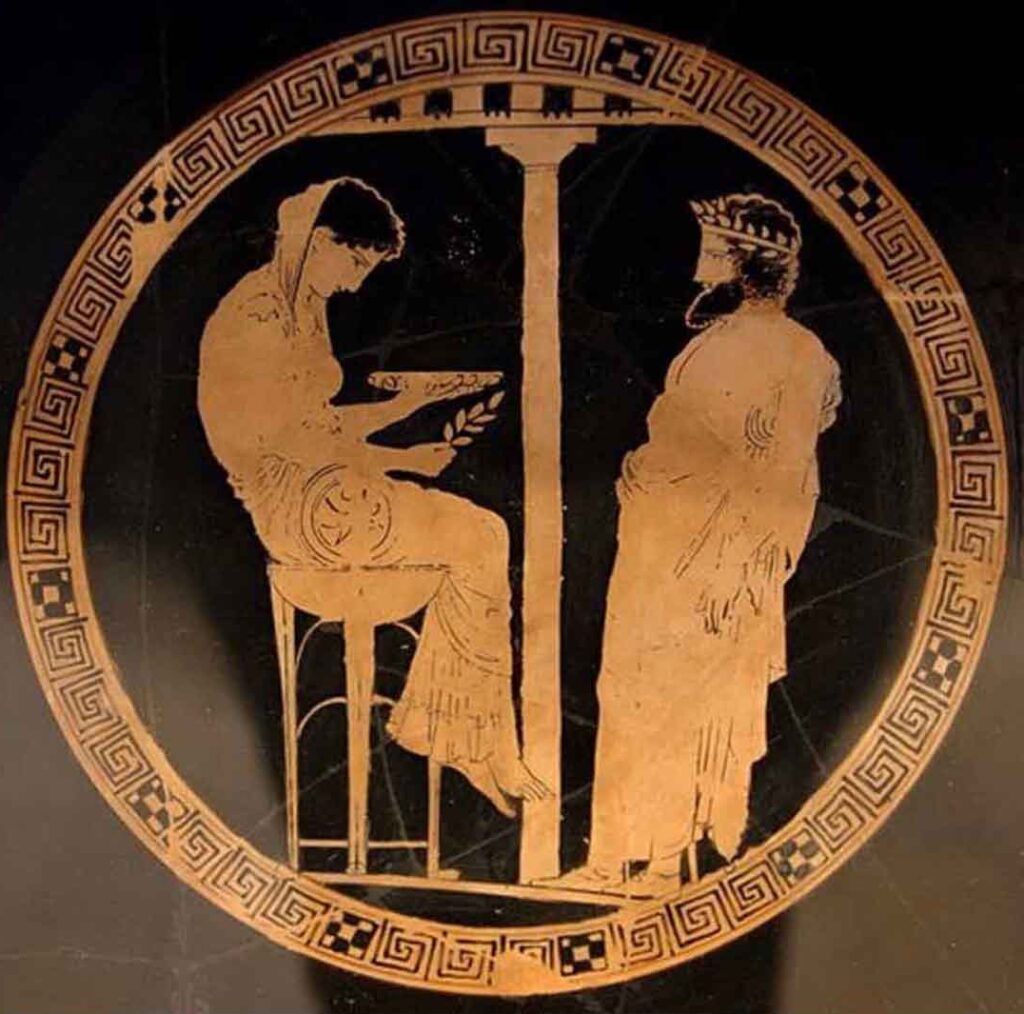
King Aegeus consults the Pythia at Delphi, depicted on an Attic red‑figure kylix (440–430 BC). The priestess holds a laurel leaf and kylix as she delivers her oracle. Image via Wikimedia Commons.
Reflections from the Sacred Path
What follows are moments from my own journey—experiences that continue to challenge the accepted narrative and illuminate the intuitive capacities our ancestors may have possessed.
Malta — Ħal Saflieni Hypogeum
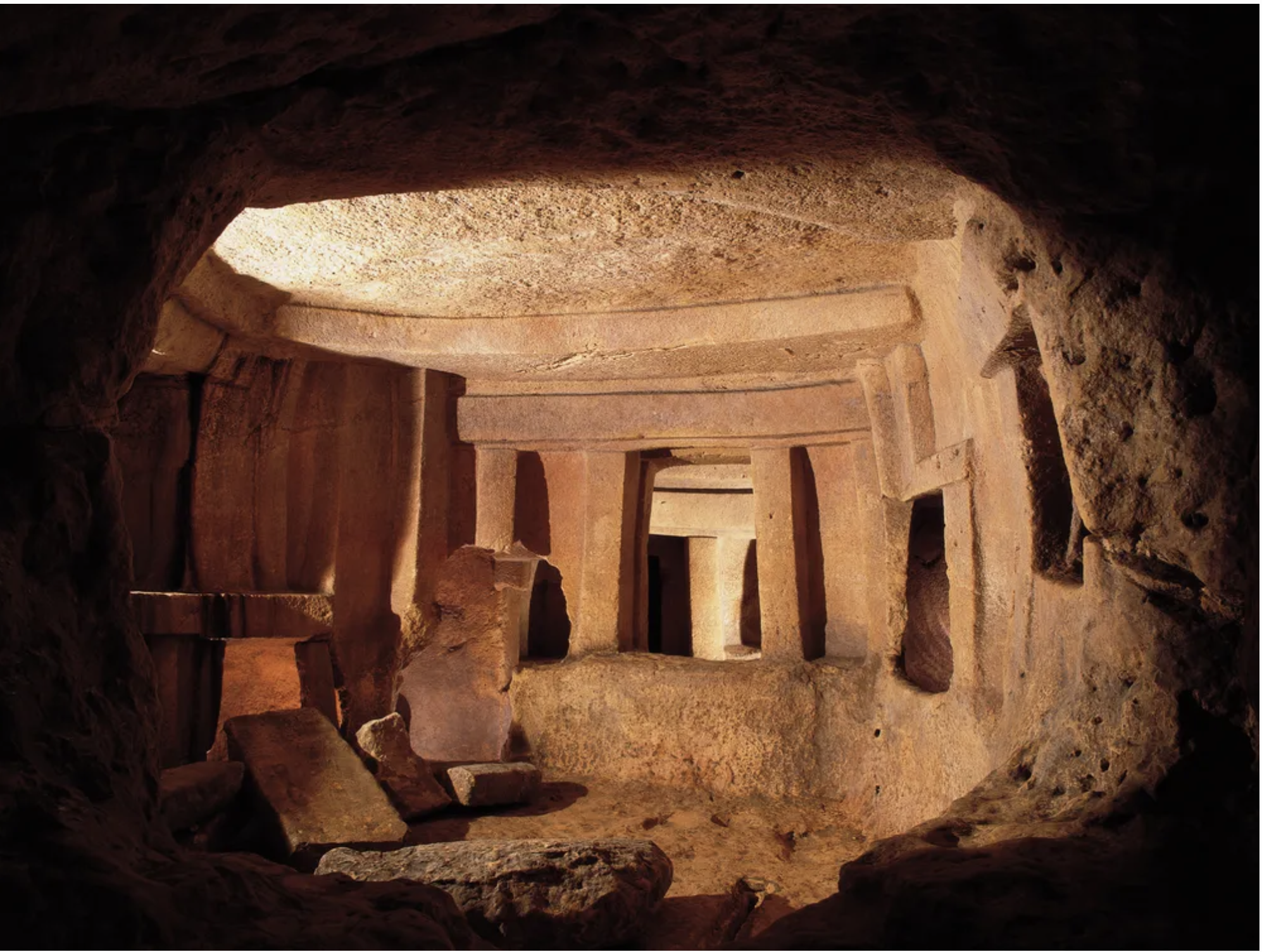
At Malta’s Ħal Saflieni hypogeum in Paola, my third eye began to turn on when the subterranean darkness was met with sound. How did our ancient priestesses navigate the narrow three-story subterranean passageways to deposit 7,000 human remains ten meters down?
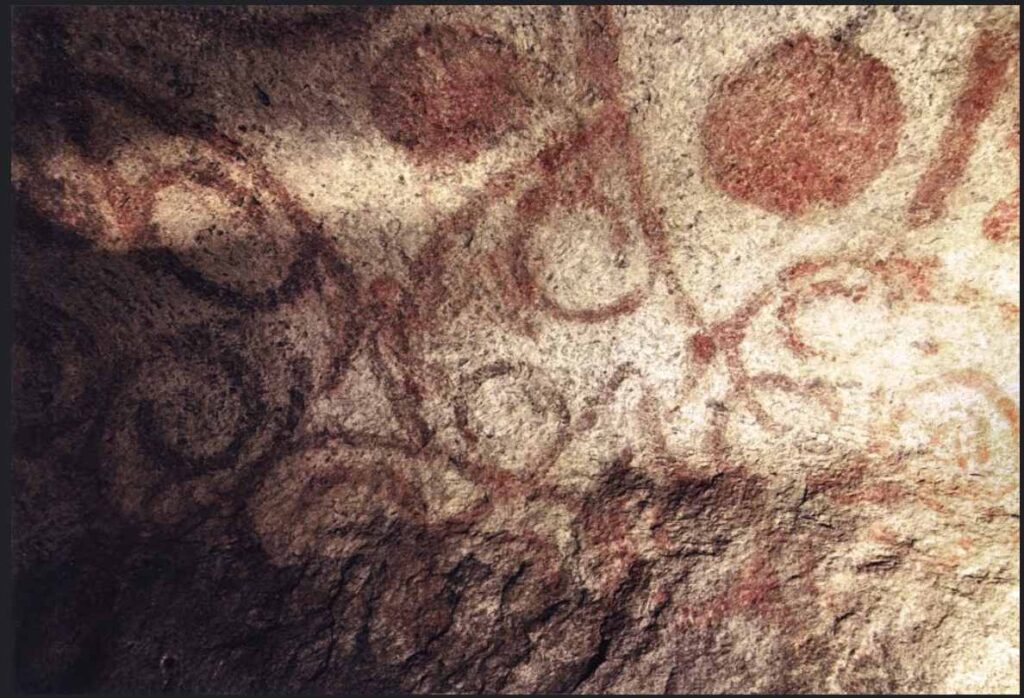
The modern narrative states fire torches illuminated their way, yet during my visit any evidence of black soot on the walls and ceiling was missing from sight. Evidence one would expect to see from use that spans around 4,000 B.C. to 2500 B.C.4 Instead, I saw red ochre markings preserved with remarkable clarity. David H. Trump, the British archeologist who reviewed the site, noted that the lower floor was decorated in red ochre as well as white and black chequers, including an image that was once a bull.5 These details speak to intention, ritual, and a sophisticated understanding of space.
Where, then, is the archeological record of scorched ceilings or soot-darkened walls? When the sleeping lady was found, was she covered in soot or the skulls that laid to rest? How did the priestesses see in the subterranean labyrinth? As I have suggested earlier, did the ancient Neolithic priestesses—and later, the oracles of ancient Greece—possess an inner sight or intuitive skill that allowed them to navigate without external light?
I wasn’t alone in questioning the official story. As one of our starseeds quipped upon exiting the site, “And they built all that with deer antler.” Her remark captured the quiet disbelief many of us felt.
My experience inside the Hypogeum continues to challenge the accepted narrative. The resonance of sound, the precision of the architecture, and the absence of soot all point toward a different kind of knowing—one that may have been inherent to those who served as intermediaries between worlds.
With Malta still echoing in my awareness, my journey continued across the ocean to another ancient site whose architecture and energy awakened a different aspect of my inner sight.
Chichen Itza — Temple of Kukulcan
At Chichen Itza in Mexico, as I stepped onto the processional walkway leading to the Temple of Kukulcan, my third eye produced a beam of light from which I could see with an enhanced vision the landscape and others in a new light. Those who had the gift of inner sight also had a light beaming from their Anja centers. Time spent at Chichen Itza led to recalled memories from a life where I experienced a group awakening into higher states of interconnection. Where one remembers another as a brother or sister, not separate and adversarial.
I was not subjected to vaporous fumes nor altered by external substances; the sites themselves had a powerful catalytic effect on me. I have never needed substances to access them. During my childhood, I had extensive inner visions including prophetic vision. This continued intermittently throughout my teen years and with the last major prophetic vision during the Bush-Gore presidential election in 2000. On election day when the votes were “too close to call”, I saw a fast-moving vision that enveloped my senses showing George W. Bush would become president, we would go to war, the housing market would collapse, and more.
The Oracles of Antiquity – Reflections on Intuitive States
In my case, prophetic vision, night vision, and psychic skills appear to be an inherent gift associated with my natural state. I believe our natural state is one of intuitive connectivity, present at birth and through early childhood, when our autonomic nervous systems are often more aligned and supportive to subtle energy. If supported, intuition could be developed, enhanced, and explored.
Our ancient ancestors built megalithic sites on specific ley lines, oftentimes in remote and difficult terrain that included fault lines. Through landscape and structure, their engineering skills combined with knowledge of astronomy created a mirror image of heaven on earth. I believe they left visual clues to remind us of this inner connection.
Psychic skills, when utilized from a balanced state of being, become our inner GPS, providing insight meant to educate, reveal, and teach us about the limitlessness of our human spirit.
“The god-goddess is you without cultural constraints or conditions; it is where you meet yourself in the rarest form, where life and love dwell.”
– Althea Provost
Works Cited
1 Jones, Gabriel. “Pythia.” Ancient History Encyclopedia. N.p., 2020. Web. 6 Mar. 2020.”Theodosius I.” En.wikipedia.org. Web. 1 Mar. 2020.
2 “Delphi.” En.wikipedia.org. N.p., 2020. Web. 1 Mar. 2020.
3 Spiller, Henry & Hale, John & Boer, Jelle. (2002). The Delphic Oracle: A Multidisciplinary Defense of the Gaseous Vent Theory. Journal of toxicology. Clinical toxicology. 40. 189-96. 10.1081/CLT-120004410.
4 Centre, UNESCO. “Ħal Saflieni Hypogeum.” Whc.unesco.org. N.p., 2020. Web. 5 Mar. 2020.
5 Trump, David H. Malta. London: Faber and Faber, 1972. Print.
©2020 Thea’s Heart, LLC™ – All Rights Reserved
Learn More About My Work
Step further into the field with the writings and teachings that shaped these journeys. If my work resonates, these offerings will deepen your understanding of the architecture within and the initiatory pathways that move through my greater work.
Four Aliens and a Funeral: A Memoir of Perception
An award-wining memoir of awakening, contact, and the subtle intelligence that reshapes a life from the inside out. Available on Amazon.
Join a Starseed Adventure
As the founder of Starseed Adventures, Althea leads immersive journeys to sacred sites around the world. These adventures offer participants the opportunity to explore ancient landscapes, engage with subtle energy, and experience the transformational power of place. Past adventures include Malta, Peru, Egypt, and other megalithic regions, with new offerings continuing to unfold.
To explore upcoming Starseed Adventures, visit her work and offerings throughout this site.